
The “Invisible Illness”
Dysautonomia (dis’-auto-no’-me-uh) is an umbrella term which includes several conditions involving the Autonomic Nervous System. This grouping of neurological conditions impact over 70 million people around the world. It has been coined the "invisible illness".
We’ve developed a holistically rooted roadmap to treat your specific path to better health and wellness. Algorithms don’t work with Dysautonomia. No two patients respond the same.
If you think you, or someone you know, might have any of the symptoms described below, know there is hope. As awareness about Dysautonomia grows, solutions become uncovered more quickly.
Intertwining Symptoms
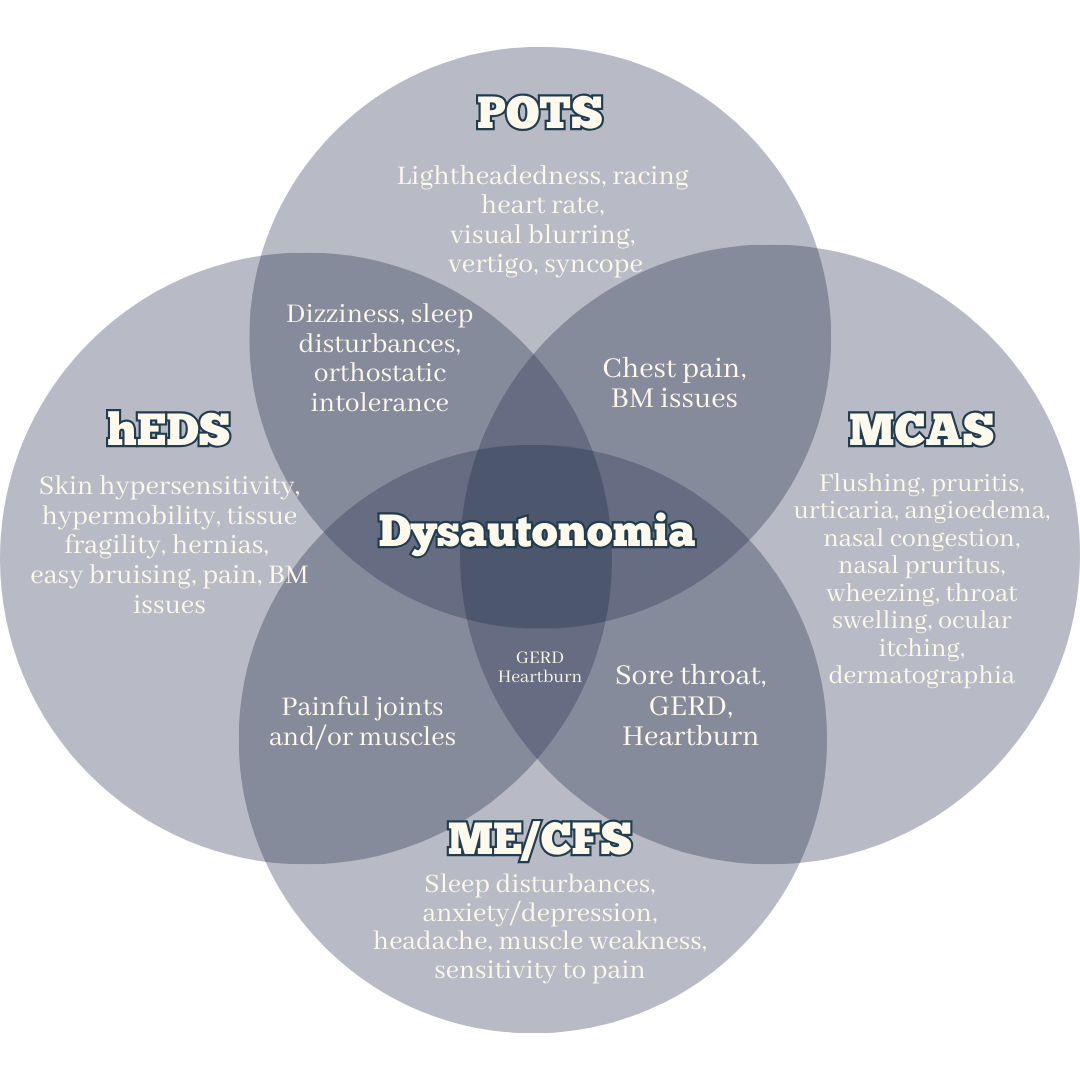
Overlap of each of these areas is not only possible, it is common. The Venn diagram to the side is not a complete depiction of those possibilities, but it is a starting point. Isolating individual problems keeps patients from receiving proper treatment. Typically each area of concern is addressed by multiple healthcare providers who are focused on their specialty. When all of the symptoms are gathered together and evaluated as a whole, rather than parts, the roadmap to healing can begin.
For example hypermobility and the tendency to faint are always not separate issues, but rather two red flags for a larger problems with the autonomic nervous system.
Symptoms common to each of the four diagnoses:
Weakness/Fatigue, Abdominal pain
Nausea, Vomiting
Diarrhea/Bloating/Constipation
Hypotension
Exercise Intolerance, Impaired cognition
Headaches, Palpitations
Frequent infections
History of concussion
-
POTS is "characterized by symptoms in multiple organ systems. It is characterized by an abnormal increase in heart rate (30 bpm in adults, 40 bpm in teens) upon standing.
POTS is a dysfunction of the autonomic nervous system that involves abnormal symptoms in many parts of the body, including abnormal blood flow to the heart, lungs and brain. It often involves problems with digestion, temperature regulation, and many other involuntary functions of the body. Because the condition involves the autonomic nervous system, which regulates mostly internal functions, it is commonly known as an “invisible illness.”" -
hEDS (Hypermobility EDS) is the most common type of EDS found with our patients. We look for excess joint mobility, signs of faulty connective tissue throughout the body (e.g. skin features, hernias, prolapses), a family history of the condition, and musculoskeletal problems (e.g. long-term pain, dislocations).
The Ehlers-Danlos syndromes are a group of genetic connective tissue disorders which are currently classified in a system of thirteen types. Despite this grouping and their common name, each type is a distinct condition caused by a different gene mutation.Do you think you have hEDS? Find your at home Beighton Score HERE for free.
-
MCAS can cause a person to have repeated severe allergy symptoms affecting several body systems. In MCAS, mast cells mistakenly release too many chemical agents, resulting in symptoms in the skin, gastrointestinal tract, heart, respiratory, and neurologic systems.
-
POTS, EDS, and MCAS can all contribute to gastrointestinal dysfunction. Patients complain of a wide variety of GI distress including (but not limited to) chronic nausea, vomiting, bloating, diarrhea or severe constipation. As a result, many have problems getting adequate animal protein in their diets. Animal protein is key to healing the intestinal tract and organ systems.
For example IBS can be linked to POTS and EDS, rather than an independent diagnosis.
Investigating digestion systematically is key to addressing the correct areas in the right order. -
Autoimmune conditions connected to Dysautonomia include Celiac disease, Hashimoto's (thyroid disease), Inflammatory Bowel Disease (including, by not limited to Crohn's Disease and Ulcerative Colitis). These can cause chronic vitamin and mineral deficiencies, dehydration, and mood disorders. When the intestinal mucosal lining is disrupted with yeast, SIBO, viruses, bacteria or other pathogens, autoimmune conditions can be triggered. Genetics dictate if you have the chance to get an autoimmune condition; lifestyle, food, and stressors/environment determine if that gene will be expressed.
-
"(EoE) is a chronic disorder of the digestive system in which large numbers of a particular type of white blood cell called eosinophils are present in the esophagus." Symptoms of EoE are often mistaken for GERD. "Common symptoms include difficulty swallowing (dysphagia); food getting stuck in the throat (impaction); nausea; vomiting; poor growth; weight loss; stomach pain; poor appetite; and malnutrition". [REF]
Additional testing by a GI physician may be beneficial. -
(ME) has also been known as chronic fatigue syndrome (CFS). ME is characterized by extreme fatigue, difficulty concentrating, sleep disturbances, pain, exercise intolerance, abnormalities with blood pressure, heart rate, body temperature regulation, and digestion. People with ME can have similar symptoms to that of POTS due to disruption of the autonomic nervous system by physical and/or mental exertion.
Endurance of postural muscles and resulting postural alignment plays a significant role in ME.
Rest typically does not improve ME symptoms.